I'm enjoying emails from folks who attended the Lend Me Your Brain workshop yesterday. Many thanks to UMass Med School Disability Evaluation Service for setting that up!
One of the topics we address in the workshop is the business of Asking Two Questions. And that kind of ongoing personal inquiry is possible to the extent that our executive functions are well-developed and trained.
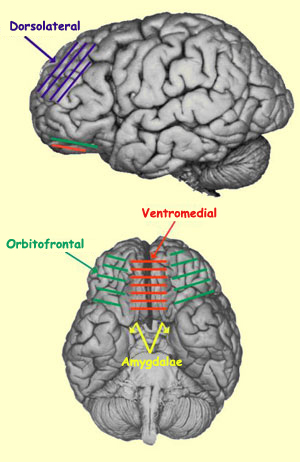
The prefrontal cortex is that part of the brain we believe supports the "executive" functions. The capacities to choose, inhibit, weigh consequences, and delay gratification are executive skills that improve with neurological maturity and are fully on-line in our early to mid-20s.
The executive functions distinguish an 18-year old from a 10-year old. Good executive functioning may also distinguish excellent college freshmen from more average students, and high-functioning middle management staff from their more average coworkers.
Less than 10% of a dog's brain consists of prefrontal cortex. Over a quarter of the human brain, on the other hand, is dedicated to managing these cognitive skills. Essentially, the "older" part of the brain - the part we have in common with most other animals - is responsible for determining "what is." The room is cool, that guy's wearing a red sweater, the cup of coffee is steaming, etc. Mice and turkeys and cats can do the "what is" part pretty well. But humans are uniquely skilled at determining "what might be." And that's the purview of the prefrontal cortex.
That's 25% of your brain dedicated to imagining (creating a mental picture) or self-talk, or otherwise thinking of a reality that has not yet happened. Essentially, the prefrontal cortex works magic. Creates experiences out of pure idea!
So we're walking around with, basically, these two brains. The "what is" part and the "what could be" part. And at our best we're asking ourselves Two Questions.
Those Two Questions are "Am I having fun right now?" and "Is this what I've set out to do"? I'm convinced that each of us is here to do and be and have something pretty specific. And if I'm doing what I'm here to do, experiencing what is mine to experience, I'll be motivated and focused and engaged. And everybody around me will benefit from that, too, just like I benefit from being the people I've known who are truly living On Purpose.
I love it when I'm able to say yes to both those questions. I'm engaged, happy, and aware that I'm doing the very best thing right now.
Often I'm doing something fun or interesting but it's that second question, "Is this what I'm here to do and be and have?" that gets me. There's an episode of "The Office" followed by another episode. And another episode after that. And it's fun to watch that. But at a deeper level I'm fairly sure that watching a lot of TV is not what I'm on the planet to do.
But the toughest answer to the Two Questions is when I'm honestly not having fun (filling out tax forms, waiting in line at the cleaners) but I'd have to say "yes" to the second question ("Is this what I've set out to do?). Because it's important to me to wear clean clothes, and to avoid tax penalties (and avoid jail, and generally be a good citizen!).
If you know anyone with executive deficits (maybe someone with ADD/ADHD or a survivor of brain injury), you might have noticed that this is someone who's much more likely to just ask the first question. "Am I having fun?" is only half the conversation we need to be conducting with ourselves, on an ongoing basis.
Hope you're having fun right now. And hope you're living the life - right now - you're here to live!
Thursday, November 4, 2010


Saturday, October 23, 2010
Cutural Competency and Lifelong Learning
After every workshop I teach, I leave with something. A book title, a website, a human story that really illustrates an important point.
And sometimes I leave with a correction, or a dressing down. Or an entirely new way of seeing something that I thought I had nailed down.
A few weeks ago, a workshop participant spoke with me during the morning break. She spoke positively of the way I was addressing some material that was particularly important for her clients, and she affirmed that she was glad she'd decided to attend the training. And then she shared a perspective with me that she thought would complement my own perspective. Something I might be missing. During the workshop I had said something I've frequently pointed out, something along the lines of "we tend to forget how toxic racism is, and the impact that prejudice has on our clients' mental health, because it's so ever-present and constant that we stop noticing it and considering it as a factor in clinical evaluation and treatment." Something like that.
And what this participant shared with me was that as I was making this comment, she was looking around and making contact with a few other attendees. And thinking to herself that she, and other people of color, do not in fact "forget" about the impact of bias and racism. Thinking in fact that "forgetting" this is a privilege that some of us cannot lay claim to. Wondering - to whom might the "we" in my comment refer?
I've shared this story with a few friends and colleagues and hope that this "ongoing cultural competency education" - this gift from a workshop participant to me - makes me an even better clinician and educator with people who are different from me in all the 57 ways that people can differ from each other.
What am I going to learn next?
And sometimes I leave with a correction, or a dressing down. Or an entirely new way of seeing something that I thought I had nailed down.
A few weeks ago, a workshop participant spoke with me during the morning break. She spoke positively of the way I was addressing some material that was particularly important for her clients, and she affirmed that she was glad she'd decided to attend the training. And then she shared a perspective with me that she thought would complement my own perspective. Something I might be missing. During the workshop I had said something I've frequently pointed out, something along the lines of "we tend to forget how toxic racism is, and the impact that prejudice has on our clients' mental health, because it's so ever-present and constant that we stop noticing it and considering it as a factor in clinical evaluation and treatment." Something like that.
And what this participant shared with me was that as I was making this comment, she was looking around and making contact with a few other attendees. And thinking to herself that she, and other people of color, do not in fact "forget" about the impact of bias and racism. Thinking in fact that "forgetting" this is a privilege that some of us cannot lay claim to. Wondering - to whom might the "we" in my comment refer?
I've shared this story with a few friends and colleagues and hope that this "ongoing cultural competency education" - this gift from a workshop participant to me - makes me an even better clinician and educator with people who are different from me in all the 57 ways that people can differ from each other.
What am I going to learn next?
Tuesday, October 19, 2010
5 Tips for Adults with ADD/ADHD
1. Marry well - pair up with someone who has great "executive skills." And find someone who "gets you" - someone who understands what a partner with ADHD brings to the table. To remind yourself, you might google "positive qualities of people with ADHD" and watch it blow up. You are probably creative, energetic, spontaneous, and fun to be around. If your partner loves that about you, and is better able to do some of the planning ahead, catching details, and goal-oriented targeted worrying, you guys might make a great pair.
2. Get a crackerjack assistant - or see what you can outsource, or see how web-based personal assistant services might work for you, or talk with your supervisor about moving some administrative support your way. What could you do (Carry the pager one extra weekend per month? Clean the break room fridge?) in exchange for two hours per week of clerical services by someone already in the organization?
3. Find a great personal planner or smartphone app, and use it for every commitment, every relationship, and every obligation. A calendar is not a scolding reminder of doctors' appointments. It's your number one tool for making sure that you are living the life you are here to live. With any luck you've got 85 years or so here on the planet. Minus your current age. Multiplied times 365. That's how many days you've got to play with (or work with). Now how do you want to use them, what do you want to do most? Write it down, break it down, and then schedule it.
4. Use a "single in-box." See David Allen's "Getting Things Done" for a great discussion of this. In your work or home office, the single in-box is an actual physical "box." In your planner or calendar app, this "in box" is your To Do list. Yep, the To Do list is a virtual "in box." It's the one place where you write down all the things you need to do, want to do, hope to you. All the phone calls you need to make, websites you want to check out, songs you want to download. One list. In fact, let's go ahead and do it; you know those 4 or 5 things that are banging around inside your head right now? The thing with the snow tires, the email from your sister, the umbrella insurance policy you wanted to check out? Write it down now. And then tomorrow when you're doing your regularly scheduled deep-checking-in with yourself (see #5), you'll review that list and move the most important ones to your calendar.
5. Set your alarm a few minutes earlier every day. Get up. Pull out your planner or your calendar app (both you and your phone are fully recharged at this point), and look at your schedule with an eye towards "what do I want to do with the time I've got today." If you're working two jobs or raising children by yourself you probably don't have too much unstructured time. And so you, of all people, have got to take this question seriously. What am I going to do with the one or two unstructured hours I have on my calendar today? What about that to-do list of everything you need to do, want to do, or dream of doing? (See #4 regarding the To Do list as an "in box"). Which one of those pops out at you right now as the most important? Alternatively, answer this question: What's the one thing that I've been putting off that would make the biggest positive difference in my life right now? So in the morning, before the day has quite started to come at you, sitting there quietly with your cup of coffee, you'll ask yourself: "What am I here to do? To Be? To have?" And you'll determine how your calendar reflects that right now.
Good luck!
2. Get a crackerjack assistant - or see what you can outsource, or see how web-based personal assistant services might work for you, or talk with your supervisor about moving some administrative support your way. What could you do (Carry the pager one extra weekend per month? Clean the break room fridge?) in exchange for two hours per week of clerical services by someone already in the organization?
3. Find a great personal planner or smartphone app, and use it for every commitment, every relationship, and every obligation. A calendar is not a scolding reminder of doctors' appointments. It's your number one tool for making sure that you are living the life you are here to live. With any luck you've got 85 years or so here on the planet. Minus your current age. Multiplied times 365. That's how many days you've got to play with (or work with). Now how do you want to use them, what do you want to do most? Write it down, break it down, and then schedule it.
4. Use a "single in-box." See David Allen's "Getting Things Done" for a great discussion of this. In your work or home office, the single in-box is an actual physical "box." In your planner or calendar app, this "in box" is your To Do list. Yep, the To Do list is a virtual "in box." It's the one place where you write down all the things you need to do, want to do, hope to you. All the phone calls you need to make, websites you want to check out, songs you want to download. One list. In fact, let's go ahead and do it; you know those 4 or 5 things that are banging around inside your head right now? The thing with the snow tires, the email from your sister, the umbrella insurance policy you wanted to check out? Write it down now. And then tomorrow when you're doing your regularly scheduled deep-checking-in with yourself (see #5), you'll review that list and move the most important ones to your calendar.
5. Set your alarm a few minutes earlier every day. Get up. Pull out your planner or your calendar app (both you and your phone are fully recharged at this point), and look at your schedule with an eye towards "what do I want to do with the time I've got today." If you're working two jobs or raising children by yourself you probably don't have too much unstructured time. And so you, of all people, have got to take this question seriously. What am I going to do with the one or two unstructured hours I have on my calendar today? What about that to-do list of everything you need to do, want to do, or dream of doing? (See #4 regarding the To Do list as an "in box"). Which one of those pops out at you right now as the most important? Alternatively, answer this question: What's the one thing that I've been putting off that would make the biggest positive difference in my life right now? So in the morning, before the day has quite started to come at you, sitting there quietly with your cup of coffee, you'll ask yourself: "What am I here to do? To Be? To have?" And you'll determine how your calendar reflects that right now.
Good luck!
Thursday, January 22, 2009
Thought Acceleration and the Hypomanic Edge
Clinicians and patients have long observed a connection between "racing thoughts" and the experience of euphoria in mania. In some ways it "feels good" to be racing along, though in true bipolar affective disorder the experience often becomes overwhelming or distressing, and is almost always followed by a period of low energy or "crash."
In his book The Hypomanic Edge , John Gartner suggests there is something uniquely American about the hypomanic experience. He offers illustrative historical figures such as Christopher columbus, Alexander Hamilton, and Andrew Carnegie as evidence that hypomania may be related to success, or some component of potential success and that it can actually be rewarded in certain organizations or systems or cultures. He's referring here to the risk-taking, slightly grandiose, euphoric feelings associated with hypomania. Others, too (e.g., Dr. Ronald Fieve
and Tom Wootton ) have pointed to the impact of manic experience on productivity and creativity.
Patients who suffer with bipolar disorder are unlikely to see the "advantage" or benefit of the condition, but are likely to report that when they are hypomanic they enjoy a sense of well-being and a capacity to get things done. And it may take several cycles or crashes to fully appreciate that the highs come at a real cost.
Still, many have mused that they wish there were some way to enjoy the productivity and pace of the "moderate" hypomanic experience - before the sleep deprivation and disorganization kick in.
As reported in the journal Emotion, Pronin, Jacobs, & Wegner found that test subjects who are instructed in thought acceleration (reading quickly or brainstorming or even narrating a silent video in fast forward) report positive affect. For these test subjects, it feels better to think faster. Here's a .pdf of the article, and here's a summer in Boston Globe article . No clinical application is described, but the obvious hypothesis emerges: could the mildly depressed individual experience a subjective mood with some of these practices, either as part of therapy or as self-administered mood management?
In his book The Hypomanic Edge
, John Gartner suggests there is something uniquely American about the hypomanic experience. He offers illustrative historical figures such as Christopher columbus, Alexander Hamilton, and Andrew Carnegie as evidence that hypomania may be related to success, or some component of potential success and that it can actually be rewarded in certain organizations or systems or cultures. He's referring here to the risk-taking, slightly grandiose, euphoric feelings associated with hypomania. Others, too (e.g., Dr. Ronald Fieveand Tom Wootton
) have pointed to the impact of manic experience on productivity and creativity.Patients who suffer with bipolar disorder are unlikely to see the "advantage" or benefit of the condition, but are likely to report that when they are hypomanic they enjoy a sense of well-being and a capacity to get things done. And it may take several cycles or crashes to fully appreciate that the highs come at a real cost.
Still, many have mused that they wish there were some way to enjoy the productivity and pace of the "moderate" hypomanic experience - before the sleep deprivation and disorganization kick in.
As reported in the journal Emotion, Pronin, Jacobs, & Wegner found that test subjects who are instructed in thought acceleration (reading quickly or brainstorming or even narrating a silent video in fast forward) report positive affect. For these test subjects, it feels better to think faster. Here's a .pdf of the article, and here's a summer in Boston Globe article . No clinical application is described, but the obvious hypothesis emerges: could the mildly depressed individual experience a subjective mood with some of these practices, either as part of therapy or as self-administered mood management?
Saturday, January 10, 2009
The Big 5
I've been kicking around, for awhile now, this idea of the Big 5. That managing our health and happiness requires regular and dedicated attention to 5 key areas:
Nutrition
Movement
Awareness of key values and motivators,
Daily consideration of time stewardship, and
Connection
The Big 5 Self-Assessment, available for free download here , allows the user to consider one's awareness of these domains and commitment to taking good care of his or her physical and mental health. I'm hoping for feedback as I continue to sketch this out and consider clinical applications.
Nutrition
Movement
Awareness of key values and motivators,
Daily consideration of time stewardship, and
Connection
The Big 5 Self-Assessment, available for free download here , allows the user to consider one's awareness of these domains and commitment to taking good care of his or her physical and mental health. I'm hoping for feedback as I continue to sketch this out and consider clinical applications.
Tuesday, January 6, 2009
Schadenfreude and "Revolutionary Road"
In a recent New York Times editorial, Judith Warner suggests that our appetite for dour representations of 1950s and 1960s domestic life (e.g., the Sam Mendes adaptation of Richard Yates' Revolutionary Road ) relates to a strange envy of that era. A doutbful and jealous curiosity about "how Dad managed to come home at 5 p.m. to read the paper or watch TV while Mom fixed dinner and bathed the kids. How Mom turned up at school, every day, unrumpled, coiffed, unflappable. And more to the point: how they managed to afford the lives that they led, on one salary, without hocking their homes to pay for college, without worrying about being bankrupted by medical bills."
) relates to a strange envy of that era. A doutbful and jealous curiosity about "how Dad managed to come home at 5 p.m. to read the paper or watch TV while Mom fixed dinner and bathed the kids. How Mom turned up at school, every day, unrumpled, coiffed, unflappable. And more to the point: how they managed to afford the lives that they led, on one salary, without hocking their homes to pay for college, without worrying about being bankrupted by medical bills." Books and movies which portrays exemplars of this generations as "frivolous, almost simple-minded depressives" and "(assign) them drunken, cheating, no-good mates" give the viewer the satisfaction of come-uppance.
A strange type of happiness is schadenfreude - taking pleasure in others' misfortunes. Like a lot of not-so-nice human behavior, schadenfreude may be rooted in our genetic history.
A 2007 study by Shamay-Tsoory and colleagues, published in the journal Brain, suggests that the ventromedial prefrontal cortex may play an important role in the experience of gloating and envy. The ability to process these emotions may depend upon the cognitive ability to put oneself in another's shoes, to recognize that others have thoughts and feelings which differ from one's own. These are central aspects of the "theory of mind" , referring to a set of cognitive capacities which may be weaker among, for example, individuals with autistic spectrum disorders.
In a way, then, our capacity for schadenfreude is the "flip side" of our brains' capacity for empathy.
And we might not always be the one observing the suffering....recognizing that we may play a role in other people's experience of schadenfreude, the cast of Avenue Q remind us that "The world needs people like you and me who've been knocked around by fate. 'Cause when people see us, they don't want to be us, and that makes them feel great!"
Friday, January 2, 2009
Claiborne Pell and Happiness
Give someone a fish, and he or she will eat for a day....teach them to fish and they eat for a lifetime. One of the greatest leadership ideas to come out of Washington was the notion that getting students through college and graduate school creates leverage. Obviously you hope to create a tax payer at a higher level, but i'm also thinking here of Gross National Happiness
- the leverage associated with creating a society of happier, more engaged people.
Former U.S. Senator from Rhode Island Claiborne Pell passed away yesterday. Under his leadership, thousands of students were able to access higher education through the Pell Grant. In fact it's because of grant and student loan programs that I'm able to do what truly makes me happy now.
...now if only they'd taught html classes when I was in school.....
- the leverage associated with creating a society of happier, more engaged people.
Former U.S. Senator from Rhode Island Claiborne Pell passed away yesterday. Under his leadership, thousands of students were able to access higher education through the Pell Grant. In fact it's because of grant and student loan programs that I'm able to do what truly makes me happy now.
...now if only they'd taught html classes when I was in school.....
Subscribe to:
Posts (Atom)


 Posts
Posts